PDF Splitter: Extract Pages From a PDF Free
Extract pages from a PDF. Pull out a range or split every page into its own file, right in your browser. 100% lossless: pages are copied exactly, text stays selectable, and nothing is ever uploaded.
Split your PDF
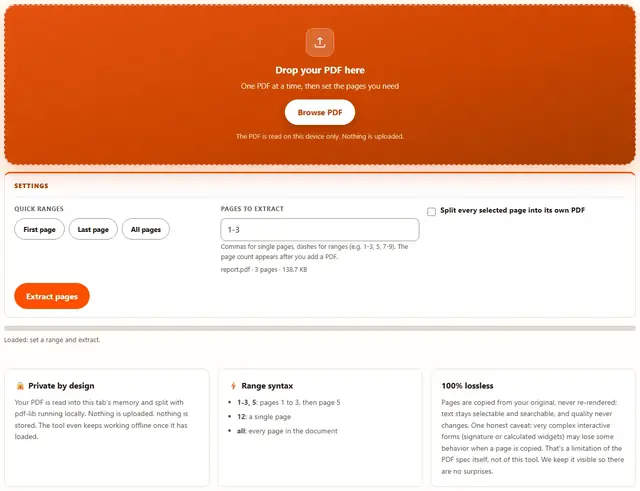
Drop your PDF here
One PDF at a time, then set the pages you need
The PDF is read on this device only. Nothing is uploaded.
Commas for single pages, dashes for ranges (e.g. 1-3, 5, 7-9). The page count appears after you add a PDF.
PDF Splitter — illustrated, step by step
How to split a PDF
Three steps. The PDF engine downloads only when you split, so the page itself loads instantly.
Add your PDF
Drag a single PDF onto the dropzone or click to browse. The page count appears as soon as the file is loaded.
Set the pages you need
Type a range like 1-3, 5, 7-9, or use the quick buttons for first page, last page or all pages. Tick the option to split every selected page into its own file.
Extract & download
Click Extract pages: the new files appear below with their exact sizes. Download them one by one, or grab everything at once.
What people split PDFs for
Submit only what's asked: send pages 3–7 of a contract instead of handing over the whole agreement.
Pull out a chapter: extract just the section you need from a report, manual or textbook.
Separate mixed scans: scanned a stack of receipts or forms in one batch? Split them apart by page and file each one where it belongs.
Grab a single form: pull out the one page you need to print, sign or fill in. Nothing else travels with it.
Troubleshooting
The range says invalid: what's wrong?
The numbers probably go beyond this document's page count. The exact count appears next to the range field once a PDF is loaded. Stay at or below it (page 1 is the first page).
It asked for a password / said the PDF is protected
Encrypted PDFs can't be read without their password. Open the file in any PDF reader and use 'Print to PDF' to make an unlocked copy, then split that copy here.
A huge PDF failed on my phone
Very large documents need memory to load. Try a desktop browser, or close other heavy tabs first: the same file usually works on a laptop.
My form fields stopped working in the extracted pages
Pages are copied exactly, so normal text and links are untouched, but complex interactive widgets (signature or calculated fields) may lose behavior when a page is copied. That's a limitation of the PDF format itself; fill and flatten such forms before splitting.
Are my PDFs uploaded anywhere?
No. Reading, splitting and downloading all happen inside your browser tab. You can verify it: open DevTools → Network, split a file, and watch nothing get sent. Privacy policy.
Can I split a PDF into separate pages for free?
Yes. Every option on this page is free with no account and no watermark: page ranges, the per-page split and unlimited runs. The result list shows each output with its page count and exact size before you download it.
Does splitting change the order of my pages?
No. Pages come out in the order you type them: 7, 3-5 puts page 7 first, then pages 3, 4 and 5, while a single run such as 3-7 stays in numeric order. The output file name records the range you used.
Learn more
Range syntax, per-page splits and real scenarios (contracts, scans, attachment limits): Split a PDF Into Separate Pages or Files.
How to extract pages from a PDF without uploading it
Most PDF websites want the file on their server first. Here the document is read into your browser tab, the pages you ask for are copied from the original, and the new file comes back for download. Nothing is transmitted, no account needed. Whether you searched for extract pages from pdf or for how to split a pdf, the steps are the same: add one file, read the page count, type the pages you need, press Extract pages.
The page count beside the field comes from your file, so the highest number you can type is never a guess. The diagram above is the whole pass: twelve pages in, one range typed, only those pages out (one combined PDF, or one file per page if the checkbox is ticked).
Split a PDF into separate pages free: no account, no watermark
Free here means the whole tool, not a preview: every page range, the per-page split and unlimited runs, no signup, no watermark. The result list gives each file its name, page count and exact size, tagged lossless, so you can check the numbers before anything is sent. Download all takes the batch, spaced a few hundred milliseconds apart; Clear all resets the field.
The PDF engine is fetched only the first time you split, from this site's own folder, so the page opens instantly. If size is your problem rather than page count, the pages you kept can go to the PDF Compressor, or read how to compress a PDF without losing quality first. Other free browser tools live on the tools hub.
Split a PDF by page range: the syntax the field accepts
The range field is a tiny language: dashes join a continuous run, commas separate single pages, and everything you type becomes one output. On load it pre-fills with the full range: 1-12 for a twelve-page file. Numbers must sit between 1 and the page count shown beside the field; anything higher returns Invalid range: use something like 1-3, 5, 7-9.
| You type | What you get |
|---|---|
1 | Page 1 alone, the same as the First page button |
1-3 | Pages 1, 2 and 3 together in one file |
2,5,9 | Three scattered pages collected into a single PDF |
1-3,5 | Four pages in total: 1, 2, 3 and then 5 |
7,3-5 | Page 7 first, then 3, 4 and 5: your input order wins |
| Last page button | The final page number, filled in for you |
Spaces are tolerated, and the output name echoes what you typed: report-pages-1-3,5.pdf.
Extract one page from a PDF and download it alone
The three quick buttons above the field handle the common cases: First page writes 1, Last page writes the final page number, and All pages restores the full range. Each then moves focus to Extract pages, so Enter finishes the job. To take an arbitrary page, type its number: 8 in a forty-page PDF selects just that page.
With the per-page box unticked, a single page is named after the range you typed, such as lease-pages-8.pdf. Tick Split every selected page into its own PDF and it becomes lease-page-8.pdf instead. The plural tells a range extract from a per-page split at a glance. Either way the page comes from your original, so page numbers, fonts and scan quality are unchanged.
How to split a PDF into individual pages
For one file per page, the per-page checkbox is the whole difference. Leave the field at the full range, tick Split every selected page into its own PDF and press Extract pages. The tool loops through the selection, writing a fresh one-page document each time: the status reads Splitting page 3 of 12… and the finish message reads Done: 12 single-page PDFs created. Files land in list order, named report-page-1.pdf, report-page-2.pdf and so on.
| What you want | What to click or type | What lands in the list |
|---|---|---|
| Only pages 3–7 of a contract | Type 3-7, box unticked | One file, contract-pages-3-7.pdf, 5 pages |
| The opening page of a report | Click First page (fills 1) | One file, report-pages-1.pdf, 1 page |
| The signature page of a lease | Click Last page (fills the page count) | One file, lease-pages-12.pdf |
| A separate PDF for every page | Leave the range, tick the per-page box | 12 files, lease-page-1.pdf through lease-page-12.pdf |
| Pages in a custom order | Type 7, 1-3 | One file: page 7 first, then 1, 2 and 3 |
Where a PDF splitter earns its keep in the US
Six real jobs and the range each needs:
- Send a lawyer only the pages they asked for. An agreement runs thirty pages, but counsel wants the indemnity section: extract
3-7and reply with five pages. - Hand an advisor one chapter. Pull chapters 2 and 3 out of a long thesis so the committee gets a focused review file, not a download nobody opens.
- Clear an attachment cap. A few hundred scanned receipts won't fit under Gmail's 25 MB limit: split it into page batches or send only what the portal asked for.
- Print one form page. When only page 4 of a multi-form package needs printing and signing, extract it so nothing else travels to the printer.
- Separate exhibits for court e-filing. County systems want each exhibit as its own upload, so Exhibit A, Exhibit B and Exhibit C land as three separate files.
- Split an appraisal for a lender. Underwriters often ask for the comparable-sales pages or the signature page alone, not the full appraisal report.
When the job runs the other way, those pages go back together in the PDF Merger, the natural opposite of this tool.
What we actually tested in the browser
Five checks we ran while building this page, and what came back:
Pages are copied, not re-rendered
Extract a range from a text-heavy PDF, then hit Ctrl+F in the result: words are still found and the cursor still selects text, proof the pages were copied from the original instead of drawn again.
What DevTools shows while you split
Keep the Network tab open and run an extraction: the only request after page load is the PDF engine itself, from this site's own folder. Your file's bytes never appear in a request body. There is no upload code path.
Password-protected files stop early
An encrypted PDF is rejected at load time with the status This PDF is password-protected. Remove the password first (Print to PDF works), then try again. Nothing partial is produced and the result list stays empty.
The per-page checkbox, end to end
Ticking it changes the loop: each selected page gets its own document and save step. The progress bar fills across the batch, and the summary line (12 pages across 12 files) matches the rows in the list.
Memory on a few hundred pages
Everything stays in the tab's memory until you download or clear it. A few hundred scanned pages is fine on a laptop; a phone may fail when memory runs out. Closing heavy tabs usually gives it headroom.
Honest limits: what this PDF splitter won't do
- Interactive form widgets and annotations may not survive. Signature and calculated fields rely on definitions stored outside the page, so a copied page can lose that behavior. Fill and flatten the form first (Print to PDF does it), then split that copy.
- PDF outlines and bookmarks may not carry over. The bookmark panel is rebuilt around the pages that were copied across, so keep the original next to your extract if the navigation tree matters.
- Encrypted PDFs must be unlocked first. An encrypted file can't be read without its password: open it in any PDF reader, use Print to PDF to make an unlocked copy, then split that.
- Extremely large files depend on device memory. Everything sits in the tab while it works, so a heavy scan pile is a desktop job: mobile browsers reach their memory ceiling sooner.
None of this is buried in fine print: the card beside the tool repeats the form caveat, and the troubleshooting answers cover the password and memory cases.
Need the opposite?
Join PDFs back together with the PDF Merger: combine files into a single document, same privacy, same speed.
Open PDF Merger