UUID Generator: v4, v1 and Nil
Generate universally unique identifiers instantly — random v4 for database keys, time-ordered v1 when you need sequence, or the all-zeros nil UUID. Bulk up to 1,000, one click to copy or download. Everything runs privately in your browser; nothing is logged, stored or uploaded.
- Cryptographically random — we use crypto.getRandomValues(), not Math.random().
- Up to 1,000 at once — bulk generate, copy all, or download as .txt.
- Format-ready — uppercase, no hyphens, or braces to match your API or DB.
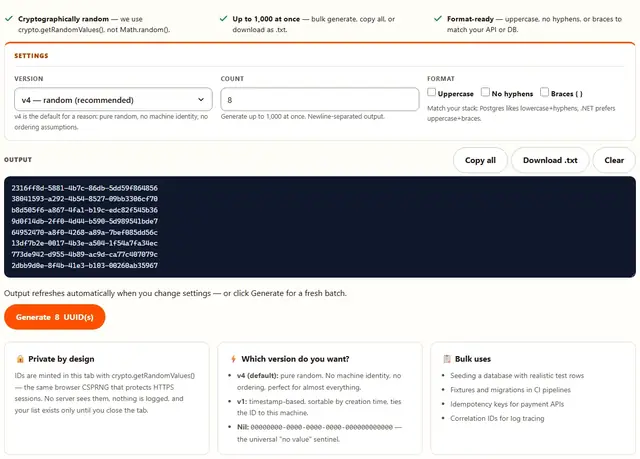
v4 is the default for a reason: pure random, no machine identity, no ordering assumptions.
Generate up to 1,000 at once. Newline-separated output.
Match your stack: Postgres likes lowercase+hyphens, .NET prefers uppercase+braces.
Output refreshes automatically when you change settings — or click Generate for a fresh batch.
UUID Generator — illustrated, step by step
How to generate a UUID
Three clicks. No account, no upload, nothing to install.
Pick a version
v4 for pure random IDs (default), v1 for timestamp-based IDs tied to this machine, or nil for all-zeros.
Generate
Click the button. Any number from 1 to 1,000 fills instantly — entirely in your browser, using the same cryptographic randomness browsers use for HTTPS.
Copy or download
Copy All grabs newline-separated IDs for your code or database, Download .txt saves them, or toggle Uppercase / No hyphens / Braces to match your stack.
Why generate UUIDs in your browser?
Not every UUID generator respects your privacy — some phone home with "anonymous usage stats" that include the output. Ours runs 100% client-side: nothing leaves your device, nothing is logged anywhere, and the page works offline after first load. Your IDs are yours.
What UUIDs solve — and which one you want
Every unique identifier debate starts with: "do I want readable, sortable, or truly unique?" UUIDs answer the third. A v4 UUID is 128 bits of cryptographic randomness squeezed into 36 characters — a collision is so improbable that generating a billion per second for a century still wouldn't make one likely.
v4 vs v1, honestly: v1 embeds the MAC address and a 100-nanosecond timestamp, which means IDs are roughly time-ordered. Useful for database locality on high-write tables; leaks machine identity to anyone who sees the ID. v4 is the opposite — no information leaks, no ordering, perfect for almost everything.
Nil UUID: 00000000-0000-0000-0000-000000000000. Every database has an "empty" sentinel. This is that sentinel. Useful in fixtures, test data, and as "the user has no parent ID" in tree structures.
Formatting for your stack: Postgres stores lowercase-hyphenated by default. .NET GUIDs prefer uppercase-braced: {550E8400-E29B-41D4-A716-446655440000}. APIs often want lowercase-no-hyphens in URLs. Toggle the checkboxes and the output matches whatever your tool expects.
UUID FAQ
What is a UUID?
A 128-bit identifier written as 32 hex digits split by hyphens: 550e8400-e29b-41d4-a716-446655440000. The v4 variant fills those 122 random bits from a CSPRNG. Two will never collide in practice — the math is on your side.
UUID v1 vs v4 — which should I use?
v4 unless you explicitly need time-sortable IDs. v1 ties to an Ethernet MAC and a counter that almost nobody wants embedded in a public-facing ID. v4 leaks nothing and is simpler to reason about.
Can I use UUIDs as database keys?
Absolutely. Postgres, MySQL, SQL Server, SQLite all have native UUID types. One caveat: random v4 IDs scatter B-tree inserts, which can fragment indexes on very high-write tables. For those, look at UUIDv7/ULID — or just accept it, because for most apps the difference is noise.
How many UUIDs can I generate at once?
Up to 1,000 per batch. Hit Generate again for another batch. Copy All pastes them newline-separated; Download saves a .txt with one ID per line.
What is the nil UUID?
All zeros: 00000000-0000-0000-0000-000000000000. Used as a "no value" sentinel in SQL, ORM fixtures, and API parameters. Safe to embed anywhere you need to mean "unset".
Are UUIDs globally unique across machines?
Yes — that's the entire point of the design. v4 uses CSPRNG entropy; v1 uses timestamp + node clock. Two machines generating UUIDs independently will never produce the same ID, assuming a working clock and no entropy failure (which would be a bigger bug than UUID collisions).
Generate your UUIDs now
Pick v4, set your count, copy or download. Free forever, no signup.
UUID Generator